

Start Feeling Better in 4-6 weeks
- Available in ALL 50 states
- Ongoing Support
4.1 ★★★★☆
9,078 reviews • Trustpilot

Relieve Menopause Symptoms
- Formulas Built for You
- Online HRT Prescriptions
4.8 ★★★★★
12,142 reviews • Trustpilot

100,000+ Happy Customers
- Is HRT right for you
- Pause or Cancel Anytime
- FREE Shipping
4.6 ★★★★⯨
7,940 reviews • Trustpilot

Menopause Treatment for just $79/mth
- Modern HRT – on Your Terms
- Pick the Path that Fits Your Body
- FSA/HSA accepted
4.6 ★★★★⯨
3,928 reviews • Trustpilot

Starting @ $59/month
- Video or Phone Visits
- Same Day Prescriptions
- Unlimited Messaging
4.5 ★★★★⯨
4,348 reviews • Trustpilot
Is Oestra™ right for You
- Balance, Prescribed
- HAS/FSA Eligible
4.1 ★★★★☆
18 reviews • Trustpilot

Starting @ $39 for your first Month
- Unlimited Support
- 24/7 Care Team
- No Hidden Fees
4.4 ★★★★⯨
16,732 reviews • Trustpilot

15% OFF Your First Order
- Built for Women & their Partners
- Trusted by 1.8 million
- FREE Delivery
4.1 ★★★★☆
11,395 reviews • Trustpilot
What Is Menopause and What Treatments Are Available?
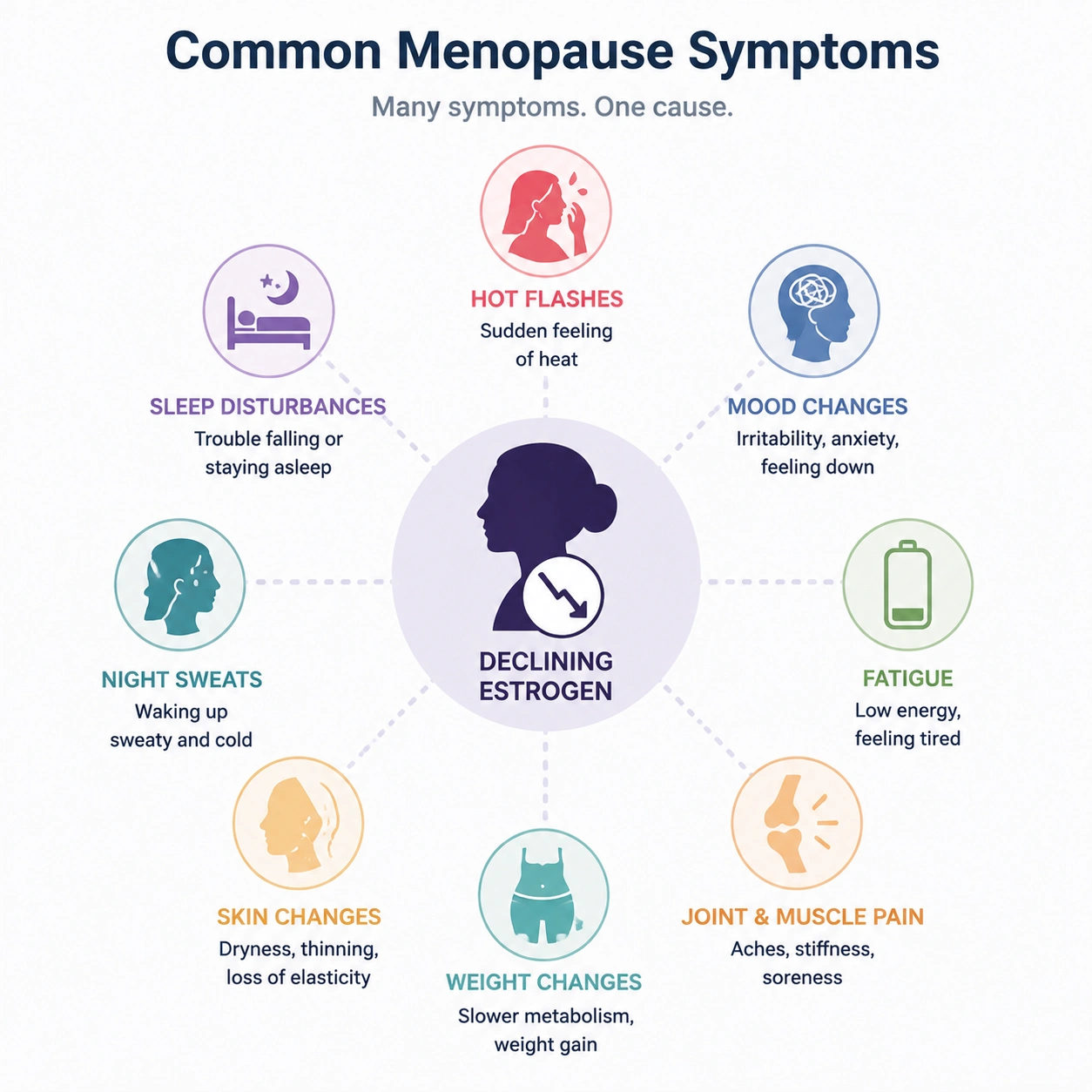
Menopause is a natural stage of life – officially marked once you’ve gone 12 consecutive months without a period – but the years leading up to it and the years after can bring a wide range of symptoms that are anything but simple to just push through. Hot flashes and night sweats tend to get the most attention, but they’re really just the most visible part of a much bigger shift. Declining estrogen and progesterone affect sleep, mood, skin, joints, and vaginal and urinary health too, which is why so many women describe menopause as touching nearly every part of daily life at once.
The good news: this is one of the most well-studied and treatable areas of women’s health, and the treatment landscape has genuinely changed for the better recently. In 2025, the FDA approved label changes removing longstanding “black box” warnings on cardiovascular disease, breast cancer, and dementia risk from several major hormone therapy products – warnings that had scared an entire generation of women away from treatment that current evidence shows is safe and effective for most healthy women within about 10 years of menopause onset. If you were told years ago that hormone therapy wasn’t an option for you, it may genuinely be worth revisiting that conversation with a provider who’s current on the latest guidance.
How Do Menopause Treatments Work?
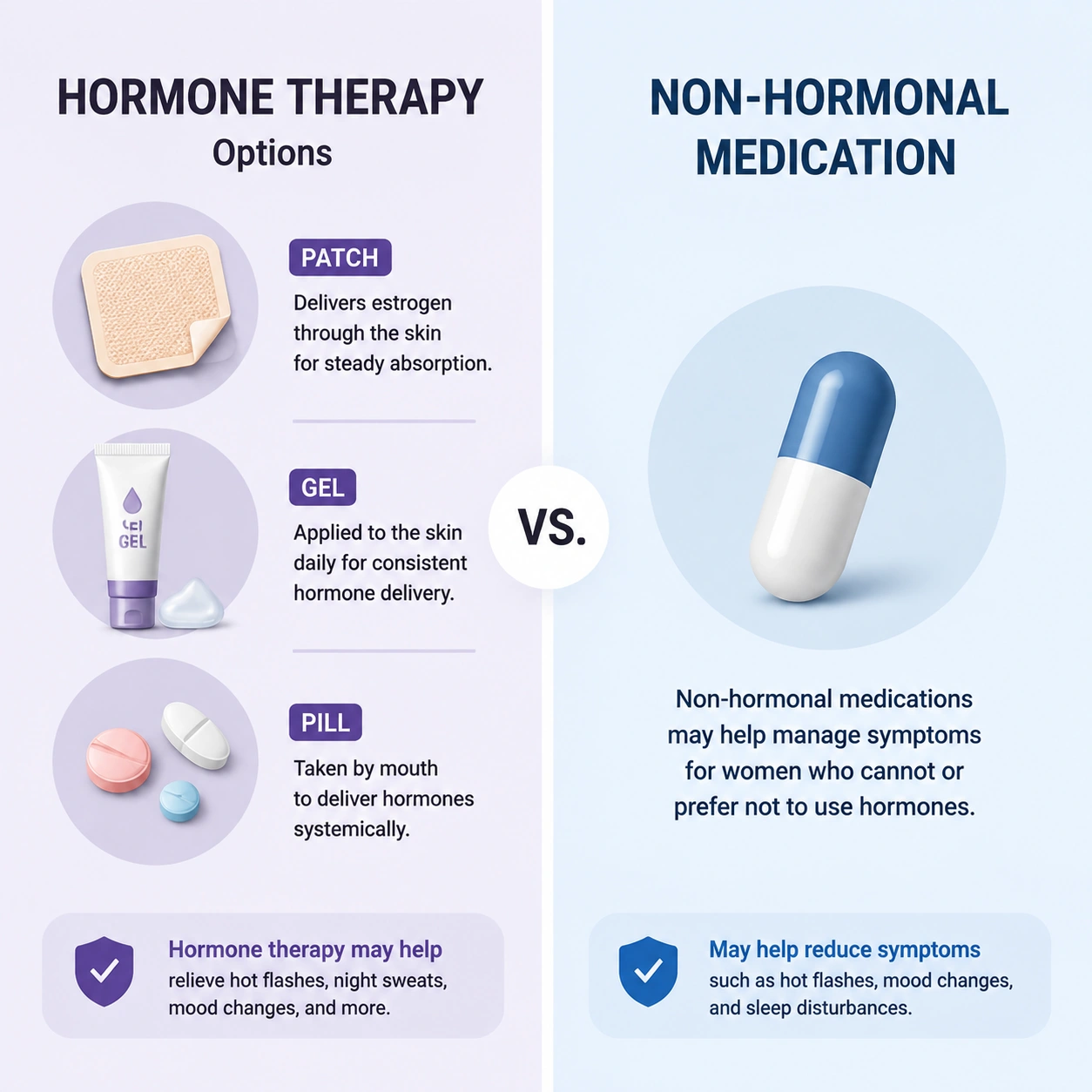
Treatment generally falls into two categories, and a good provider will help you figure out which fits your situation:
Hormone Replacement Therapy (HRT) – the most effective option for moderate to severe symptoms, HRT works by replacing the estrogen (and, for women with a uterus, progesterone) that your body stops producing. It comes in several forms:
- Patches – worn on the skin and changed once or twice weekly, delivering a steady dose
- Gels – applied daily to the skin
- Oral tablets – taken daily by mouth
- Vaginal formulations – creams, rings, or tablets specifically for genitourinary symptoms like dryness and discomfort, with minimal systemic absorption
Non-Hormonal Options – for women who can’t or prefer not to use hormone therapy, newer non-hormonal medications target the specific brain pathway responsible for hot flashes directly, offering meaningful relief without hormones at all. This has been one of the more significant recent advances in menopause care, giving women a genuinely effective alternative rather than just “toughing it out.”
Is Hormone Therapy Right for You?
For most healthy women who are within about 10 years of their final period or under age 60, HRT is now considered both safe and highly effective for moderate to severe symptoms – a significant shift from the more cautious guidance of the past two decades. That said, it’s not universal, and a provider will look at your full picture before recommending it, including:
- Age and how many years since your last period
- Personal and family history of blood clots, certain cancers, or cardiovascular disease
- Whether you still have a uterus (which determines whether progesterone needs to be part of the plan)
- Severity of symptoms and how much they’re affecting daily life
Women experiencing surgical menopause (from ovary removal) or premature ovarian insufficiency (menopause before age 40) are often strong candidates for longer-term hormone therapy, since they’re managing a longer stretch of estrogen deficiency than women going through natural menopause at a typical age.

What Results Can You Expect?
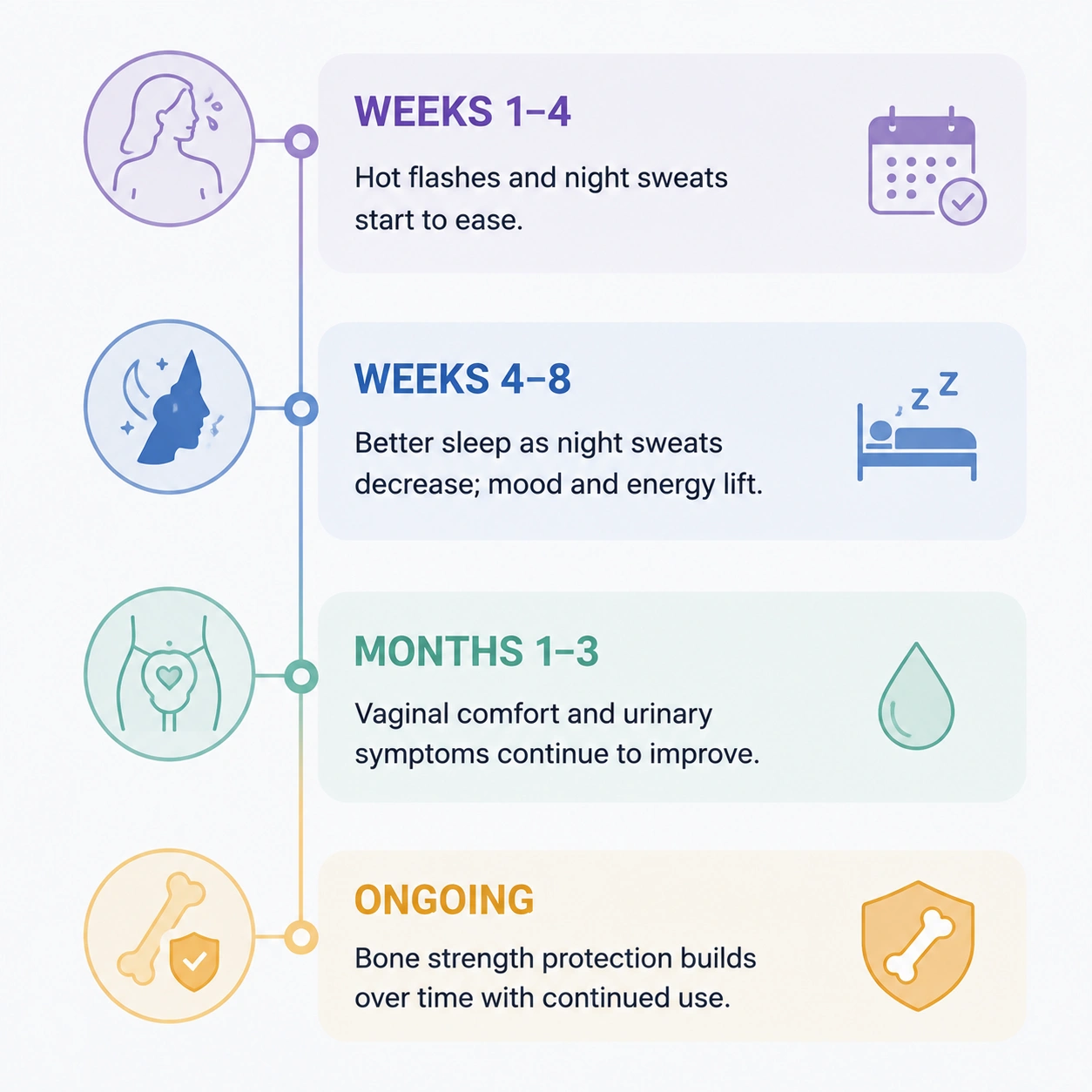
Relief timelines vary by symptom and treatment type, but here’s a general pattern many women experience:
- Weeks 1-4: Hot flashes and night sweats often begin improving within the first few weeks of starting hormone therapy, though full effect can take longer
- Weeks 4-8: Sleep quality frequently improves as night sweats settle down, which tends to have a ripple effect on mood and energy too
- Months 1-3: Vaginal and urinary symptoms, if present, typically continue improving with consistent use, especially with localized vaginal formulations
- Ongoing: Bone density protection is a longer-term benefit that builds with continued treatment, particularly relevant since estrogen decline accelerates bone loss
Non-hormonal options for hot flashes specifically also tend to show improvement within a similar few-week window, giving women without a good HRT fit a real alternative rather than no options at all.
Potential Side Effects
Like any hormone therapy, HRT comes with things worth knowing about, even though recent FDA guidance has clarified that the risks are lower than once believed for most healthy candidates.
Common, usually mild side effects:
- Breast tenderness
- Bloating
- Headache
- Nausea, particularly when starting oral formulations
- Irregular spotting, especially in the first few months
Effects worth discussing with your provider:
- Blood clot risk, which varies by formulation (transdermal patches/gels generally carry lower clot risk than oral tablets)
- Any personal or family history of hormone-sensitive cancers, which factors into whether HRT is appropriate
Non-hormonal options carry their own, generally milder side effect profile, since they don’t involve replacing hormones directly – worth discussing as an alternative if HRT isn’t the right fit for you.
This is general information, not medical advice. A licensed provider can walk you through your personal risk factors and help you choose the right formulation and dose.
Frequently Asked Questions
Is hormone replacement therapy safe?
For most healthy women within about 10 years of menopause onset, current evidence and updated FDA guidance support HRT as both safe and effective for moderate to severe symptoms. In 2025 the FDA removed longstanding black-box warnings about cardiovascular disease, breast cancer, and dementia risk from several major HRT products, reflecting an updated understanding of the evidence. That said, individual risk factors still matter, which is why a proper medical evaluation is the right first step.
What's the difference between hormonal and non-hormonal treatment?
Hormone therapy replaces the estrogen (and often progesterone) your body stops producing, addressing the root hormonal shift directly. Non-hormonal medications instead target the specific brain pathway responsible for hot flashes, offering relief without hormones – a good option for women who can’t or prefer not to use HRT.
How long do I need to stay on treatment?
This varies significantly by individual and is a conversation to have with your provider – some women use HRT for a few years to manage the most intense transition period, while others, especially those with surgical or early menopause, may benefit from longer-term use.
Do I need to see a specialist, or can my regular doctor prescribe this?
Many primary care providers and OB/GYNs can prescribe HRT, but given how much the guidance has evolved recently, seeing a provider with current, specific training in menopause medicine can make a real difference – especially if you’ve previously been told HRT wasn’t an option for you.
menopauselineup.com is a free online resource that offers reviews and comparisons of companies and the products and services they provide. All representations and warranties regarding the accuracy of the information are disclaimed. Company trademarks featured on our site are the property of their respective trademark holders and listings on our site do not imply endorsement. menopauselineup.com does not claim to represent every available company, product, or service existing in the market as a whole.
menopauselineup.com may receive compensation from the companies featured on this site. All forms of rankings, evaluations, reviews, and opinions featured on this site are determined internally and subjectively. The menopauselineup.com team works hard to keep site information up to date, but all information is presented “as is” and should not be assumed accurate.
All users of this site are subject to the site’s “Terms of Use.”